
Table of Contents
- Reducing Concrete Shrinkage Cracks in Roofing Projects
- Fundamentals of Concrete Shrinkage
- Deep Dive into Shrinkage Restraint and Additives
- Practical Strategies for Minimizing Concrete Slab Cracking
- Advanced Techniques in Shrinkage Compensation
- Frequently Asked Questions on Crack Prevention
- Key Takeaways for Effective Crack Prevention
Reducing Concrete Shrinkage Cracks in Roofing Projects
In the demanding climate of Los Angeles County, where flat commercial roofs endure intense sun and occasional heavy rains, concrete shrinkage cracks can emerge as a hidden threat. Homeowners and property managers in Westlake Village often seek ways to reduce concrete shrinkage cracks before they lead to leaks or structural weaknesses. We at Roofland understand these challenges, drawing from our extensive experience in roofing services to help clients maintain durable structures.
Definition: Concrete Shrinkage Cracks
Concrete shrinkage cracks form due to the material’s volume reduction during the curing process. As concrete hydrates, it loses moisture and undergoes chemical changes, resulting in internal stresses that cause fissures. According to industry standards, concrete can shrink up to 0.1% by volume, a seemingly small figure that nonetheless compromises integrity over time.
These cracks arise primarily from drying shrinkage, where surface moisture evaporates, and chemical reactions during hydration. Minimizing shrinkage in concrete requires attention to mix design and curing conditions, especially in roofing applications like substrates under tiles or supporting slabs. Controlling cracks in slabs is crucial for flat roofs, where unchecked shrinkage can lead to water infiltration and costly damage.
To highlight key causes, the following table outlines common types and their roofing implications:
| Cause Type | Description | Impact on Roofing |
|---|---|---|
| Drying Shrinkage | Moisture loss leading to surface contraction | Weakens roof substrates, causing leaks |
| Autogenous Shrinkage | Self-desiccation in low-water mixes | Affects new construction roofs with early stresses |
| Chemical Shrinkage | Hydration reactions generating internal volume change | Induces stresses in concrete under metal roofs |
This overview underscores how environmental and material factors drive shrinkage, setting the stage for effective strategies. Prevention begins with proper mix proportions and curing techniques, including the use of shrinkage compensating concrete to offset volume loss.
We at Roofland integrate concrete crack prevention into our comprehensive services, such as thorough inspections and targeted repairs. For instance, in areas like Thousand Oaks, roof repair in Thousand Oaks addresses crack-related issues in local commercial buildings. Our experts ensure compliance with regional codes while promoting long-term durability.
As we explore fundamentals in the next sections, from basic mechanisms to advanced techniques, you’ll gain insights to safeguard your property against these common pitfalls.
Fundamentals of Concrete Shrinkage
At Roofland, we frequently encounter issues related to concrete shrinkage in roofing projects across Los Angeles County, particularly in flat roofs and structural supports. This volume reduction in concrete can compromise the integrity of roof bases if not addressed early. Our inspections help identify potential problems before they escalate, ensuring durable installations for residential and commercial properties in areas like Westlake Village.
Understanding Shrinkage Mechanisms
Concrete shrinkage arises from internal changes that cause the material to contract, often leading to cracks that affect roofing substrates. Drying shrinkage, the most common type, occurs as moisture evaporates from the concrete surface, resulting in typical reductions of 0.06-0.08% as noted in industry standards. This process creates tensile stresses on the surface, especially in exposed roof slabs where environmental exposure accelerates evaporation. In high-performance mixes used for modern flat roofs, autogenous shrinkage happens due to self-desiccation during hydration, where internal moisture is consumed without external drying, leading to early-age cracking in structural supports.
Understanding these mechanisms is crucial for roof durability, as they directly influence the performance of concrete under roofing membranes. Restraint to shrinkage, where surrounding elements prevent free contraction, exacerbates the issue by inducing cracks.
Definition: Restraint – The resistance to movement imposed by adjacent structures or older concrete, amplifying shrinkage effects.
A key factor is the water-cement ratio; higher ratios increase porosity and subsequent drying, while lower ratios in dense mixes heighten autogenous risks. In our experience with Los Angeles-area constructions, such as commercial flat roofs in Westlake Village, unchecked shrinkage has led to surface cracks that allow water infiltration under roofing layers. To reduce concrete shrinkage cracks, early mitigation through proper mix design proves essential.
The following table outlines the primary shrinkage types and strategies to address them:
| Shrinkage Type | Cause | Prevention Method |
|---|---|---|
| Drying | Evaporation of moisture | Proper curing and sealing |
| Autogenous | Self-desiccation in hydration | Lower cement content in mixes |
| Chemical | Reactions during hydration | Shrinkage-compensating admixtures |
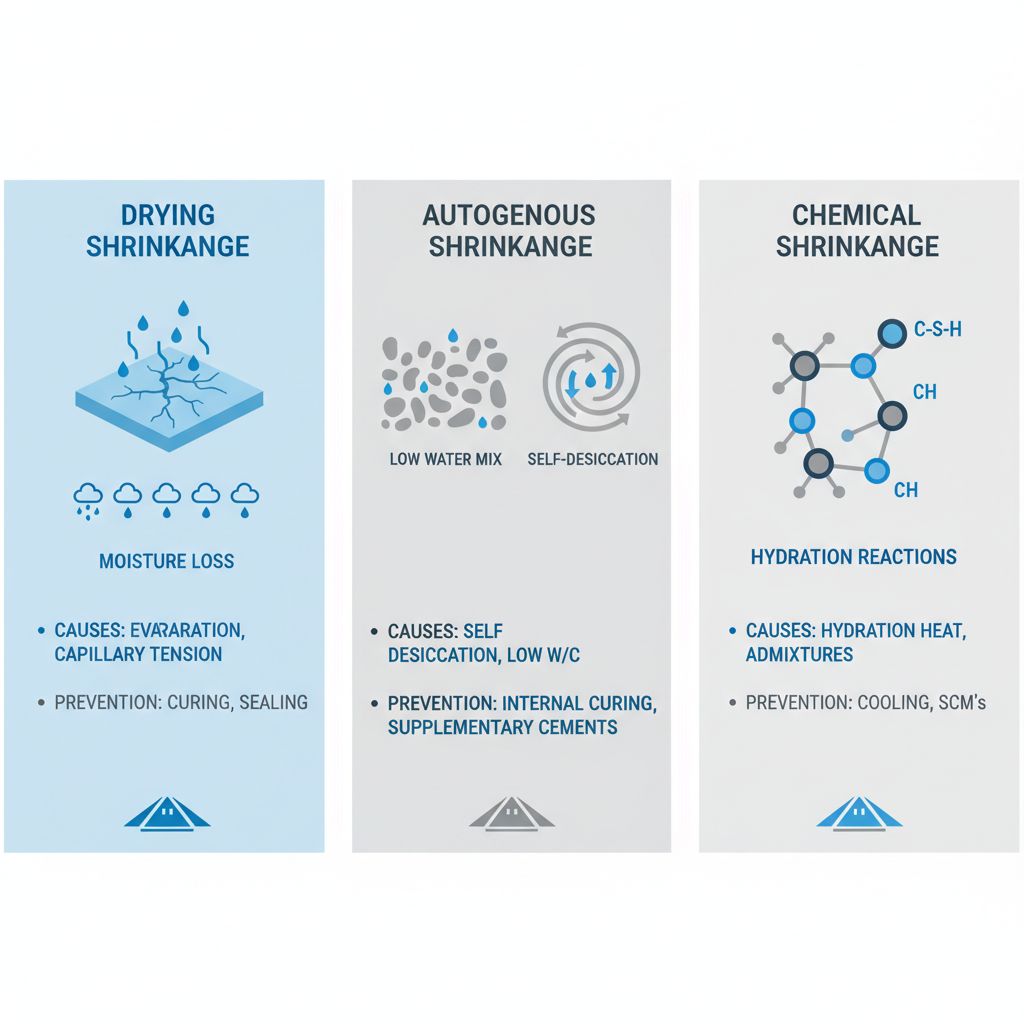
Visual guide to concrete shrinkage fundamentals in roofing contexts
Role of Control Joints in Prevention
Control joints serve as premeditated weak points in concrete slabs, designed to direct where cracks will form and thus maintain structural integrity in roof bases. These joints relieve stresses from shrinkage and temperature fluctuations, preventing random fissures that could undermine roofing installations. In construction practices for flat roofs, we at Roofland emphasize strategic joint placement to align with pour sequences and load paths.
Definition: Tensile Stress – The pulling force within concrete that leads to cracking when exceeding the material’s strength, often triggered by restrained shrinkage.
Contraction joints, spaced every 15-20 feet per guidelines from transportation standards, are sawn into the slab mid-depth to control drying shrinkage cracks. This approach ties seamlessly to concrete crack prevention in roofing, where joints under membranes ensure even load distribution without compromising waterproofing.
| Joint Type | Placement | Benefits for Roofing |
|---|---|---|
| Contraction | Mid-slab, every 15-20 ft | Controls random cracks, protects membrane adhesion |
| Construction | At pour lines or interruptions | Eases installation, maintains base continuity |
Deep Dive into Shrinkage Restraint and Additives
At Roofland, we recognize that shrinkage restraint stands as the leading culprit behind concrete cracking in roofing applications. This phenomenon arises when concrete attempts to contract during curing but faces opposition from surrounding elements, generating tensile stresses that exceed the material’s strength. In roofing structures, such as flat roofs or support bases, these stresses can compromise the entire system’s integrity, leading to leaks and costly repairs. Understanding restraint mechanisms allows us to recommend proactive strategies that safeguard long-term durability in projects across Los Angeles County.
Restraint Mechanisms in Concrete
Internal restraint occurs within the concrete itself, primarily through aggregate interlock, where coarse particles bind together as the cement paste shrinks, creating localized tensile forces. External restraint comes from surrounding structures like formwork or adjacent concrete pours, which resist the slab’s natural contraction. In roofing projects, structural restraint from rebar or ties embedded in roof decks intensifies these effects, amplifying stresses that propagate cracks across surfaces exposed to thermal cycling.
We often liken restraint to a locked door preventing a room from settling evenly—without relief, the building strains under pressure. Research from concrete shrinkage studies indicates that tensile stresses can reach 2-3 MPa under restrained conditions, surpassing the typical 2 MPa tensile strength of early-age concrete. This mismatch explains why random cracks frequently appear in roof slabs poured without adequate planning. To address this, incorporating control joints in concrete provides deliberate weak points, guiding cracks to controlled locations and preserving aesthetic and functional integrity.
| Restraint Type | Source | Mitigation Strategy |
|---|---|---|
| Internal | Aggregate bonds | Fiber additives |
| External | Formwork friction | Early removal |
| Structural | Rebar ties | Joint placement |
Additives for Crack Reduction
Additives play a pivotal role in reducing concrete shrinkage cracks by altering the mix’s behavior during hydration and drying. We recommend shrinkage compensating concrete formulations, which incorporate expansive agents to offset contraction through controlled expansion. Types include expansive cements that generate ettringite crystals for slight volume increase, shrinkage-reducing admixtures (SRAs) that lower surface tension in pores to minimize capillary stresses, and synthetic fibers that bridge micro-cracks before they widen.
In roofing mixes for flat roofs or solar integrations, these admixtures enhance performance: expansive cements ensure uniform expansion up to 0.05%, countering drying shrinkage of 0.03-0.08%. SRAs can cut tensile strains by 50-80%, as supported by industry research, while fibers like polypropylene distribute loads effectively. Mix design adjustments, such as adding 15-20% fly ash, further refine workability and reduce heat of hydration, promoting denser microstructures.
| Additive Type | Function | Roofing Benefit |
|---|---|---|
| Expansive Cement | Volume expansion | Durable flat roofs |
| Shrinkage-Reducing Admixtures | Lowers tension | Maintenance ease |
| Fibers | Bridges cracks | Solar panel integrations |
Case Studies in Roofing Applications
In a commercial project in Los Angeles County, a multi-story office building’s concrete roof deck experienced severe restraint issues from tightly spaced rebar grids, leading to widespread micro-cracking during initial curing. External formwork friction exacerbated internal aggregate bonds, resulting in tensile stresses that fragmented the surface. By retrofitting with shrinkage-reducing admixtures in subsequent pours, the team achieved a 60% drop in crack density, restoring waterproofing integrity without full replacement.
Practical Strategies for Minimizing Concrete Slab Cracking
At Roofland, we understand that concrete slab cracking can compromise the integrity of roofing structures, from flat roofs to foundation supports in commercial and residential projects. Our experience in Los Angeles County highlights the importance of proactive measures to maintain slab durability. By focusing on curing, joint placement, mix design, and on-site practices, we help clients achieve long-lasting results. These strategies align with our commitment to reliability, expertise, and experience, ensuring professional roofing services that prioritize quality.
Curing and Joint Placement Techniques
Proper curing is essential for reducing concrete shrinkage cracks in roofing applications. We advise maintaining moisture through methods like wet burlap coverings or curing compounds for at least seven days, ideally extending to 14 days for optimal strength development. According to industry standards from the PACA, outlined in preventing random cracks in concrete, wet curing reduces shrinkage by 40%, preventing early-age cracks that could affect roof stability.
| Curing Method | Duration | Effectiveness |
|---|---|---|
| Wet Burlap | 7 days | High moisture retention |
| Curing Compounds | Full cure | Easy application for roofs |
| Plastic Sheeting | 14 days | Prevents rapid drying |
Mix Design and Material Selection
Selecting the right mix design plays a pivotal role in practical shrinkage control for concrete used in roofing. We recommend low water-cement ratios, ideally below 0.45, to limit excess water that exacerbates shrinkage. Supplementary materials like fly ash or silica fume can further mitigate this by reducing heat generation and improving density.
| Material | Benefit | Application in Roofing |
|---|---|---|
| Fly Ash | Reduces heat, eco-friendly | Green roofs |
| Silica Fume | Increases strength | Commercial slabs |
| Aggregates | Graded for less restraint | Residential bases |
On-Site Best Practices for Roof Projects
For roof projects in Los Angeles, such as those in Calabasas or Agoura Hills, on-site execution is key to minimizing cracks. We start with thorough subgrade preparation, ensuring a uniform, well-drained base free of frost or organic material to reduce settlement risks.
Advanced Techniques in Shrinkage Compensation
Specialty Admixtures and Concretes
Specialty admixtures and concretes represent cutting-edge solutions for managing shrinkage in high-risk roofing elements. Type K expansive cement, for instance, generates controlled expansion through ettringite formation, compensating for drying shrinkage by up to 0.05% as outlined in ACI guidelines. This approach is ideal for restrained conditions where tensile stresses could otherwise lead to cracks. Shrinkage-reducing polymers, or SRAs, work differently by lowering surface tension in the pore water, reducing capillary pressures and thus minimizing contraction by 30-50%. We often recommend these in projects requiring high-performance crack mitigation.
| Technique | Expansion Rate | Suitability for Roofs |
|---|---|---|
| Type K Cement | 0.02-0.05% | Flat roofs, high restraint |
| SRA Polymers | Reduces 30-50% | Solar integrations, dynamic loads |
| Hybrid Mixes | Combined effects | Green roofs, vegetation support |
Integration in Roof Construction
Integrating advanced shrinkage compensation into roof construction demands tailored strategies, especially for innovative systems like solar and green roofs in Los Angeles. For metal roofs, we incorporate fiber reinforcements alongside shrinkage compensating concrete to boost tensile strength and resist thermal cycling. In solar-integrated projects, these concretes stabilize mounting bases, preventing differential movement under panel loads.
| Roof Type | Advanced Method | Benefit |
|---|---|---|
| Metal | Fiber-reinforced mixes | Enhanced durability, crack resistance |
| Solar | Compensating concrete bases | Load stability, long-term alignment |
Frequently Asked Questions on Crack Prevention
Q: What causes concrete shrinkage cracks?
A: Concrete shrinkage cracks result from drying shrinkage as moisture evaporates, leading to contraction. Excess water in the mix, poor sub-grade preparation, and inadequate curing exacerbate this issue, creating tensile stresses that exceed the concrete’s strength.
Q: How do control joints prevent random cracks?
A: Control joints create planes of weakness in concrete slabs, directing cracks along predetermined lines rather than randomly. Cut to one-quarter slab depth within 6-18 hours of placement, with spacing up to 18 feet for effective crack control methods.
Q: How does this relate to roofing, and what should we do?
A: Cracks in concrete roof decks can lead to leaks requiring urgent attention. For emergency roof repair in Camarillo, contact us at Roofland for inspections and repairs to ensure structural integrity and prevent water damage.
Key Takeaways for Effective Crack Prevention
To reduce concrete shrinkage cracks and ensure long-term roofing durability, homeowners should prioritize understanding key causes such as rapid drying and temperature fluctuations. Implementing control joints and using shrinkage compensating concrete can effectively support concrete crack prevention, while additives and proper curing practices aid in overall shrinkage management. We recommend proactive inspections to catch potential issues early, preventing minor problems from escalating into major structural concerns.
Resources
- Get 24/7 Emergency Roof Repair in Thousand Oaks
- Secure Rapid Emergency Roof Repair in Camarillo
- Find Expert Roof Repair and Replacement in Oak Park
- Obtain Comprehensive Roof Repair Services in Calabasas
- Discover Professional Roof Repair in Agoura Hills
- Explore Reliable Roof Maintenance in Oak Park
- Access 24-Hour Emergency Roof Services in Calabasas
- Learn Concrete Shrinkage Causes and Mitigation Strategies
- Understand Control Joints for Rigid Pavement Integrity
- Prevent Random Cracks in Concrete Slab Construction
- Explore Geopolymer Concrete Shrinkage Reduction Techniques